" I believe in the fable that the Fates fell in love with Hermes. "
" Mediator. Mediation. There is nothing else; there is no Immediate known to us. "
" A good symbol is the best argument. . . The value of a trope is that the hearer is one; and indeed Nature itself is a vast trope, and all particular natures are trope ... All thinking is analogizing, and 'tis the use of life to learn metonymy. " Ralph Waldo Emerson
The Twins, the third sign of the zodiac, associated with the messenger deity Mercury/Hermes, is the first sign of the element Air, and houses the Sun at the births of many writers. It is the first sign that has language at its disposal.
The symbol of the Twins denotes any and all copula, their functions and manifestations, from the intimate to-and-fro of personal interaction, to all forms of mediation, transition, re-presentation, mirrors and specula, iteration, duplication or multiplication, mimesis and similarity. Hieroglyph, stylus and pen, typeface, word, metaphor, language, dialogue, translation, figuration, photography, all spring from the Twin's mutual address. Gemini, the third sign, looks back and sees only two things, the majestic parental binary of Aries and Taurus, and channels all its creativity through the revelation of AND.
Dante Alighieri in Paradise honored the "glorious Twins" thus:
. . . . o stars
impregnate with great strength,
to whom I owe whatever genius
I possess, with you the sun
arose and set when first
I
breathed sweet air of Tuscany.
Each of the three books of the Divine Comedy ends with the word "stelle." Dante taxes us to experience pre-Copernican astronomy and astrology not yet fully separated. In Dante's comprehensive vision anything believed of the heavens, mythological or geometrical, signifies spiritually.
Ralph Waldo Emerson, a translator of Dante, reaches for the stars continually:
"Astrology interested us, for it tied man to the system. Instead of an isolated beggar, the farthest star felt him, and he felt the star. However rash and however falsified by pretenders and traders in it, the hint was true and divine, the soul's avowal of its large relations, and, that climate, century, remote natures, as well as near, are part of its biography." (The Conduct of Life: Beauty)
"Every astronomical fact interested him," Emerson's nephew recalled, but his perspective was entirely symbolic. "I think," he wrote, " I could have helped the monks to belabor Galileo for saying the everlasting earth moved." According to a friend: "The majesty of planets and suns and systems, in their ordered courses, especially appealed to Emerson from youth. . . . In the years between 1835 and 1845 his journals, and the scattered fragments of "The Poet" show how constantly he sought "the sweet influence of the Pleiades" and "Arcturus and his sons."
Divine inviters, I accept
The courtesy ye have shown and kept
From ancient ages for the bard.
. . . . . . . . . . . .
I watch your course,
Who never break your lawful dance
By error or intemperance.
O birds of ether without wings!
O heavenly ships without a sail!
O fire of fire! O best of things!
O mariners who never fail!
Sail swiftly through your amber vault,
An animated law, a presence to exalt.
"I am part of the solar system. Let the brain alone, and it will keep time with that, as the shell with the sea-tide." Emerson looks to the stars with a philosophical yearning and a poetical mood and a downright belief in sympathetic influence that have little to do with astronomy.
America's first popular astrologer, William Chaney, adopted Emerson's "Hitch your wagon to a star" as his motto.
W. B. Yeats casts horoscopes obsessively. His Geminian Sun murmurs "Mirror on mirror mirrored is all the show." He was enamored by the idea of a generative principle which he called the "antithetical self", as unreachable as the image in the mirror.
Gay Gemini poet Walt Whitman reaches out to "Poets to come!" Gay Gemini poets reply in echo: Garcia Lorca (Ode to Walt Whitman), Allen Ginsberg ("What thoughts I have of you tonight, Walt Whitman . . ") and Portuguese poet Fernando Pessoa (Salutacion a Walt Whitman), who left trunkloads of unpublished astrological papers, pleads (in English):
With the higher trifling let us world our wit
Conscious that, if we do it, that was the lot
The regular stars bound us to, when they stood
Godfathers to our birth and to our blood.
Gemini Joyce Carol Oates added a name to the list of Pessoa's hundred-odd heteronyms. In a Yeatsian trance, a "real or imagined 'possession'", she "translated" fully 22 stories (a satisfying Gemini number) by her imaginary Portuguese author, Fernandes de Briao, collected in the volume "A Poisoned Kiss". In explanation Oates cryptically invokes Yeatsian antitheses. "Everything about her had two sides to it," Oates wrote in her most famous story, and in her natus the Gemini itself is one side balanced against another, a powerful Persephone archetype. Her novel based on the life and death of Marilyn Monroe, also a Gemini, was written under the working title Gemini, then renamed Blonde; Oates' antithetical autobiography in a way.
Allen Ginsberg relished his birthstars, as here:
This universe a thing of dream
substance naught & Keystone void
vibrations of symmetry Yes No
. . . . all the way down to the first Wave
making opposite Nothing a mirror
which begat a wave of Ladies marrying
waves of Gentlemen till I was born in 1926
in Newark, New Jersey under the sign
sweet Gemini ---
. . . . . .
. . . I correspond with hopeful
messengers in Detroit, I am taking drugs
and leap at my postman for more correspondence, Man is leaving
the earth in a rocket ship,
there is a mutation of the race, we are no longer human beings,
we are one being, we are being connected to itself,
it makes me crosseyed to think how, the mass media assemble
themselves like congolese Ants for a purpose
. . . . .
communicate with me
by mail post telegraph phone street accusation or scratching at my window
and send me a true sign I'll reply special delivery
DEATH IS A LETTER THAT WAS NEVER SENT
Allen Ginsberg
As promised by its title, Joseph Brodsky's "To Urania: Collected Poems 1965-1985" inclines to astrology, she being the Muse of that science. The title poem responds to the 1960 "Homage to Clio" of Brodsky's mentor, W. H. Auden (n.b. not a Gemini). Late Auden is permeated with this discouraging principle: 'Poetry makes nothing happen'. In "Homage to Clio" Auden submits to the realpolitic of history (whose Muse is Clio), to rationalization and disenchantment. He rejects Zodiacal illusions: "We may dream as we wish / Of phallic pillar or navel stone // With twelve nymphs twirling about it, but pictures / Are no help".
In Brodsky's youthfully Geminian, optimistic counterview the very ubiquity of limitation and division in the sub-lunary world privileges Urania's transcendental exploration over Clio's scrolled archive. Gemini is ever the gadfly to the realist. Urania's profounder Self ("the/body's absence") is a spiritual giant who strides the upper atmospheres like Dante ascending (or a passenger in an airplane), observing Earth's majestic shifts from above.
Everything has its limit, including sorrow.
. . . That's why Urania's older than sister Clio! ('To Urania')
So Brodsky rejects Auden's dispiriting obeisance to necessity. Having known prison he is not one to chip away at the possible meanings of freedom, but will keep faith even if narrowed to a twinkling point.
Auden doesn't think Clio reads his poems, or should, while Urania leans over Brodsky's shoulder as he writes. She pops up often, indirectly in the collection's first poem, May 24, 1980, which is the poet's fortieth birthday -- and two days before Pushkin's birthdate. (Urania implicitly attends all birthday poems.) The brotherhood of Brodsky and Pushkin is common critical currency. They are the Castor and Pollux of Russian literature, as the two Geminis, Emerson and Whitman, are of American, and May 24, 1980 is a compendium of Pushkin/Brodsky resemblances, in tone, meter, rhyme scheme and incident. The Dantesque enters as well: "From the height of a glacier I beheld half a world, the earthly / width."
In Lithuanian Nocturne Brodsky plunges into the most obvious Gemini terrain. In a teleported visitation, with allusion to Girenas and Darius, a legendary pair of doomed Lithuanian airmen, Brodsky address fellow poet his distant friend Thomas Venclova on the subject of their shared literariness: "Our inkpot alliance! It's splurge!/ . . Our imprints!" Then a full outcry of the Twin's need to pair:
Thomas, we are alike;
We are, frankly, a double:
. . . We're a mutual threat,
Castor looming through Pollux,
We're a stalemate, no-score,
Draw, . .
Echoes tracing in vain the original cry . . .
In Stanza XV Urania appears in her glory (and to the disadvantage of Clio). Brodsky's thoughts of Venclova, transcending political boundaries, unite in the upper atmosphere with Venclova's thoughts of Brodsky to become
A specter . . .
simply note in this faint apparition a kin
or an aspect of air--like these words, with their fear of the morning,
Scattered thinly at midnight by some slurring voice --
. . . . but in which
ever-naked Urania is to rejoice!
In Stanza XVII, Brodsky addresses Urania again: "Muse of dots lost in space! Muse of things one makes out / Through a telescope only!") and sings to her four dithyrambic stanzas ("a little aria") on the subject of Air, Breath and Speech, which resounds with the afflatus, pneuma or prana of the element Air at the roots of indo-European astrological imagery.
In the kingdom of air!
In its equality of
gulps of oxygen to our syllables! . . .
. . . our O's
shape the vault of the palate,
where a star gets its shine from the vat
of the throat! That's how the universe
breathes.
Two memorable times in his youth, Brodsky has told us, he experienced "astronomical illuminations" while gazing at the stars, and he regretted (to an interviewer in 1988) that they had never recurred. In The Fifth Anniversary, a dejection ode, the poet tries to talk himself out of silly beliefs. It opens:
A falling star, or worse, a planet (true or bogus)
Might thrill your idle eye with its quick hocus-pocus.
. . . there are no enigmas, signs in heavens."
Yet Gemini is compelled optimistically to his Penmanship: "Scratch on, my clawlike pen, my pilgrim staff, my salvage!"
Again, in one of his Christmas poems he is disillusioned with the stars: "well after hours, blinking . . . and a thoughtful gaze can be rested on none of these."
Astrology is confrontational in Gorbunov and Gorchakov, Brodsky's important novel-in-verse, a poetic genre which few but Geminis attempt. (Pushkin, of course, and Pope ("Why did I write? What sin unknown / Dip't me in ink, my parents or my own?"), Thomas Moore, and, more recently, Vikram Seth and Anne Carson.) The most extended of Brodsky's several conversation poems, it contains the astonishing Canto V (A Song in the Third Person), an x-ray of the bones of dialogue. The subject of Canto X is the primacy of language:
"And so it's not the sea that surges in-
to shore, but words are overlapping words."
"And words are sort of holy relics." "Yes."
The two protagonists are political prisoners in a mental ward. Gorchakov is Brodsky, an intellectual, Gorbunov, his antithetical self, a peasant. Gorbunov consults the stars, Gorchakov mocks them. Gorbunov describes himself in astrological terms, then asks
"And you, What is
your sign?" "Well, I belong to Gemini.
Born under Gemini, in May." "I guess
that makes you warm." "I guess." . . .
Our normally garrulous and provocative Gorchakov is suddenly laconic, unresponsive. His contempt for astrology is belied by his all-too obvious Geminian qualities. Ironically, the obvious fact that Gemini fits him to a T stops his complusive flow of words. Pre-telescopic Urania, who developed geometry out of observation of the stars, is always represented with a compass, and Gorbunov argues with Uranian metaphor:
"You're
forgetting that, although the radius
is scorned in life, the compass will endure
forever, Gorchakov."
The usual allowances for problems of translation aside, Brodsky still makes good points, often with pointed, if slightly accented language. Nothing perishes faster in translation than the sheen of an intricate rhyme scheme, except perhaps delicate conversational gradations of Slavic irony and mood. The notorious "untranslatability" of Brodsky (echoing that of Pushkin) is a fitting part of his Geminian literariness. Adding to his labors and his substance as a personage, Brodsky was not only his own translator, but editor and collaborator with a stable of translator colleagues. Brodsky is a hero of border-crossing, so charmingly grateful for the freedom offered by the West that we English reader generously excuse the inevitable awkwardness. We lean forward to understand -- what communicator could ask for more?
"Indeed, a star that climbs above the field
seeks out a brighter interlocutor."
To unite the beginning and the end of this essay, and justify my eccentric practices, I submit quotes from Brodsky and Emerson:
"The surest defense against evil is extreme individualism, originality of thinking, whimsicality, even — if you will — eccentricity." JB
"I would write on the lintels of the doorpost, Whim. I hope it is somewhat better than whim at last, but we cannot spend the day in explanation." RWE
Addendum: Other poets born under Gemini: Thomas Moore, Mark van Doren, Harry Crosby, Josephine Miles, Gwendolyn Brooks, Bob Dylan, Nikki Giovanni, John Yau, Lucie Brock-Broido, Paul Muldoon, David Lehman, Anne Carson
--- Mark Shulgasser
astrodreamer.squarespace.com
wkkbooks@localnet.com
.
 Monday, June 22, 2009 at 05:10PM
 for her. Yet that might be the very disjunction that explains her anguish. She gave herself to the camera, that is, to the state of being duplicated and multiplied, promiscuously and compulsively. Hedda Hopper, herself a Gemini (and note that both ladies rechristened themselves with alliterative names, gracing their self-created identities with the primitive charm of doubleness), observed Monroe's relation to the camera:
 she did. . . In her brain and body the distinction between woman and actress had edges sharp as razor blades. Off camera she was a nervous, amazingly fair-skinned creature almost beside herself with anxiety about her roles, driven to seek relief in vodka, champagne, sleeping pills—anything to blunt the pain of her existence. When the camera was there she became an actress, using her eyes, her hands, every muscle in her body to court and conquer the camera as though it were her lover, whom she dominated and was dominated by, adored and feared.” ---Hedda Hopper, The Truth and Nothing But (sic)
 MM & HH: 2 Geminis and a mirror
 after all, not a bodyguard or back-up dancer. She was continually communicative, on the phone, kept in touch with everybody, even her distant half-sister, who wrote a book about her.
 Two Geminis with cameras
  Gemini JFK avoided being caught in a photo with her, save in this rare shot taken on the sly, which includes the bonus features treasured by Gemini watchers: the Brother and the Library.
 Two Geminis with phone
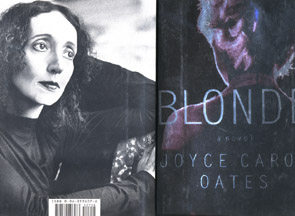 Gemini novelist Joyce Carol Oates announced Marilyn as her alter-ego or secret twin in the jacket art of her novel BLONDE, which had the working title of GEMINI, and is full of reflections on Gemini, including an extended fantasy of a sexual relationship between Monroe and a pair of handsome twins. A powerful chapter treats the occasion on which Monroe sang Happy Birthday to JFK. Years later tragic history repeated itself as farce when Gemini opera singer Beverly Sills sang Happy Birthday to Gemini Henry Kissinger.
 (found stereogram)
 (photo by Milton H. Greene)
